
Jeep Safari Pakistan
- 14 days, July to mid-September
- 4x4 with driver throughout
- Four passes above 4,000 m
- Deosai plateau, 4,114 m
- Hunza and Baltistan in one trip
- Hotels, and one night under canvas
- Maximum three jeeps
- 14-day itinerary
About this tour
A jeep safari in Pakistan is the only way to join up the parts of the north that ordinary tours make you choose between. Most itineraries pick a side: Hunza and the Karakoram Highway, or Skardu and Baltistan. Fourteen days in a 4x4 takes both — and then adds the roads between them that a coach cannot use, which is where the trip stops being sightseeing and starts being travel.
Four passes above 4,000 metres. The Babusar Pass at 4,173 m, where the Kaghan valley ends and the Indus basin opens out in front of you. The Khunjerab Pass at 4,693 m on the Chinese border, the highest paved frontier crossing in the world and the top of the old Silk Route. And the two crossings onto and off the Deosai plateau, which averages 4,114 m, sits above the treeline for its entire extent, and is the second-highest plateau on earth after the Tibetan.
About half the route is sealed road and about half is not. The unsealed half is corrugated gravel, plank bridges over glacial rivers, and a certain amount of shelf road with a drop on one side. You travel four to a jeep, so nobody sits in a middle seat for two weeks and everyone has a window, with a driver who has run these roads for years and a guide across the convoy. Every night is booked ahead — hotels and guest houses where they exist, and a full-service camp on Deosai where they do not.
Deosai is the reason most people book this rather than a road tour. It is a national park of nearly two thousand square kilometres on a plateau of open grassland with no trees anywhere on it: wildflowers to the horizon through July, marmots on every bank, streams the colour of glass, and around seventy-seven Himalayan brown bears — up from roughly twenty when the park was created in 1993, and flat for the last four years, which is a conservation story that is not finished. You cross it in a day and sleep on it for a night, and the night is the one people talk about afterwards.
The rest of the route is the north's greatest hits taken in the right order. Fairy Meadows under the Raikot face of Nanga Parbat, reached by the jeep track from Raikot Bridge that is the most discussed piece of road in the country. Karimabad, with Baltit and Altit forts and the Eagle's Nest at Duikar. Attabad Lake, the Passu Cones and Gojal on the run to the Chinese border. Skardu, the Shigar valley and the cold desert. And the Indus itself for days at a time, from the gorge below Chilas to the wide grey valley above Skardu.
What it asks of you is time in the seat and a tolerance for dust. Driving days run from four to eight hours with stops, there is one optional walking day and nothing else longer than an hour, and the highest you sleep is 4,114 m on Deosai after a fortnight of working up to it. It suits photographers, it suits anyone who has done a Hunza road tour and wants the half of the north they missed, and it suits families with older children. It does not suit anyone who dislikes long days in a vehicle, because that is the trip, and we would rather say so here than have you find out on the Babusar road.
Trip highlights
A night camped on the Deosai plateau
Nearly two thousand square kilometres of national park above the treeline at an average of 4,114 metres, crossed in a day and slept on for a night. In July it is wildflowers to the horizon, marmots on every bank and a real chance of a Himalayan brown bear at distance.
Four passes above 4,000 metres
Babusar at 4,173 m, Khunjerab at 4,693 m on the Chinese border, and the two crossings onto and off Deosai — the reason this is a jeep safari and not a road tour.
Both halves of the north, joined up
Hunza, Karimabad and the Karakoram Highway on the way up; Skardu, Shigar and Baltistan on the way back — linked by the Deosai track rather than by driving the same road twice.
Fairy Meadows and the Raikot face
Nanga Parbat at 8,126 m reached the way it should be: the jeep track up from Raikot Bridge, which is the most talked-about piece of road in Pakistan, then ninety minutes on foot through the pines.
The Khunjerab Pass and the old Silk Route
North through Gojal past Attabad Lake and the Passu Cones to the highest paved international border in the world at 4,693 m — yaks, marmots, a line of trucks and the Chinese gate.
Four to a jeep, three jeeps at most
Twelve travellers maximum. Everyone has a window, the convoy can stop when the light is right, and a driver who knows these roads is with you for the whole fortnight rather than swapping at each stage.
Route
- 1 Start
- 2 Stop in order
- 9 Finish
- Route travelled
Loading map…
At a glance
- 14 days, July to mid-SeptemberThe only window when Babusar, Khunjerab and the Deosai tracks are all open at once.
- 4x4 with driver throughoutFour to a jeep. No middle seats, and everyone gets a window.
- Four passes above 4,000 mBabusar 4,173 m, Khunjerab 4,693 m, and both Deosai crossings.
- Deosai plateau, 4,114 mThe second-highest plateau on earth, crossed in a day and camped on for a night.
- Hunza and Baltistan in one tripMost itineraries make you choose between them. This one does not.
- Hotels, and one night under canvasEverything booked ahead. Deosai is the exception, and it is a full-service camp.
- Maximum three jeepsTwelve travellers at the most, and usually fewer.
Day by day
Day 1Arrive Islamabad — meet the jeeps and the drivers

Met at the airport and driven to the hotel. Dinner, and a proper briefing rather than a handshake: the route, the passes, what the rough days are like, what to keep in the jeep and what can go in the bag on the roof. You meet the drivers who will be with you for the whole fortnight — on a jeep safari they matter more than any other part of the arrangement, because they are the people reading the road. Anyone arriving early can spend the spare hours in Islamabad's Margalla foothills or at the Faisal Mosque, both twenty minutes from the hotel.
Day 2Islamabad to Naran, up the Kaghan valley

Out through Abbottabad and into the Kaghan valley, following the Kunhar river up to Naran at 2,400 metres. Six to seven hours, the last of it climbing, on tarmac the whole way. This is the gentle start by design: pine forest, roadside trout, and a night that begins the acclimatisation for tomorrow's pass. If the afternoon is clear there is time to run up to Saif-ul-Malook, the lake above the town, before the light goes.
Day 3Over the Babusar Pass — 4,173 m — to Chilas

The first real jeep day and one of the best on the trip. Up past Lulusar lake and onto the Babusar Pass at 4,173 metres, where the Kaghan valley ends and the whole Indus basin opens out in front of you with Nanga Parbat somewhere in the haze to the north. Down the far side in a long series of switchbacks to the Karakoram Highway and Chilas, and the temperature climbs about twenty degrees on the way. Babusar is open roughly April to September and is one of the two things that set this trip's season — an early snowfall closes it overnight, and we carry the Karakoram Highway alternative for exactly that.
Day 4The Raikot jeep track and the walk up to Fairy Meadows

The jeep track up from Raikot Bridge — narrow, unsurfaced, cut into the side of the gorge and by some distance the most discussed piece of road in the country. Local drivers own this stretch and nobody else drives it, which is not a formality; it is a one-vehicle-wide shelf with passing places. It ends at Tato, and from there it is about an hour and a half on foot, or on a pony, up through the pines to Fairy Meadows at 3,300 metres, with the Raikot face of Nanga Parbat filling the whole end of the meadow.
Day 5Fairy Meadows — the one walking day, and it is optional

The only day with real walking in it, and nobody has to take it. Up through the last of the trees to Beyal camp and on towards the Nanga Parbat base camp viewpoint, four to five hours return, for the closest look at the Raikot face you can get without a climbing permit — 8,126 metres of mountain rising in one uninterrupted sweep from the glacier below it. Or stay in the meadow, read, and watch the face change colour all afternoon, which plenty of people choose and nobody regrets. Second night at Fairy Meadows, which is also a real acclimatisation night at 3,300 m.
Day 6Down to the Karakoram Highway and north to Karimabad
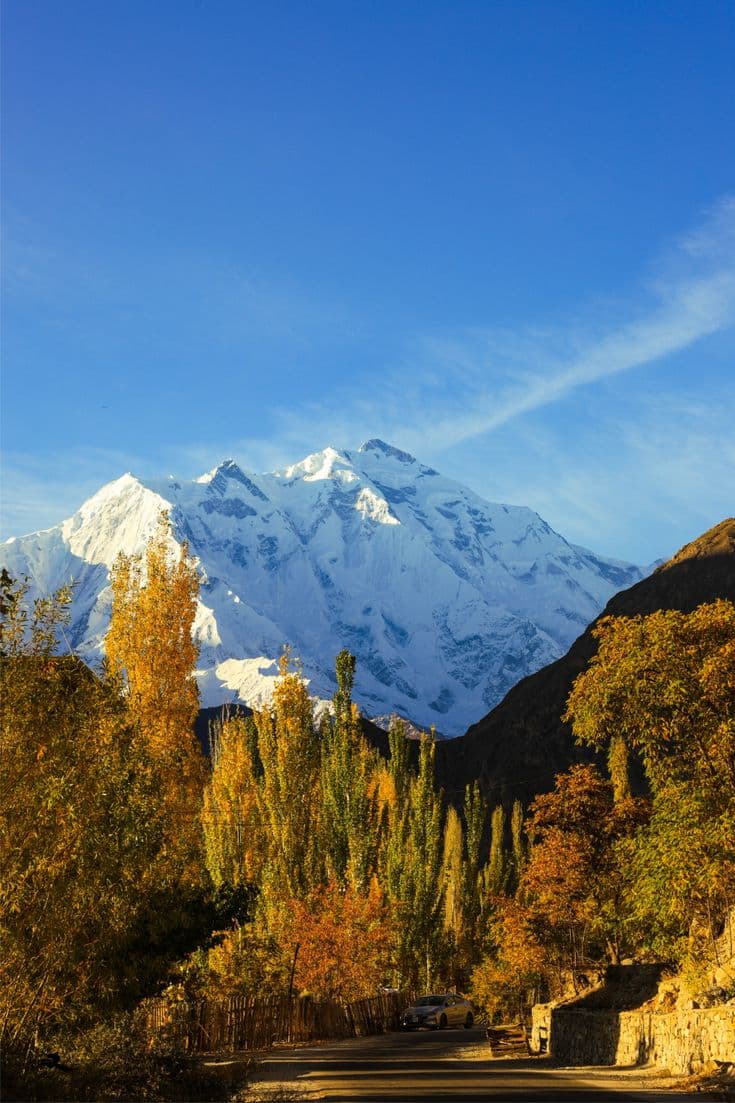
Back down the track to Raikot Bridge and onto the Karakoram Highway proper — the old Silk Route, following the Indus past the junction where the Himalaya, Karakoram and Hindu Kush meet, then turning up the Hunza river past the Rakaposhi viewpoint, where 7,788 metres of mountain stands more or less directly above the road. Into Karimabad in the afternoon for three nights, and a hotel with the Ultar wall out of the window after two nights at altitude.
Day 7Karimabad — Baltit Fort, Altit Fort and Duikar at sunset

Baltit Fort above the town, around seven centuries old and pulled back from collapse by a restoration that is studied internationally, and Altit below it — older still, with the royal garden and the apricot orchards between the two. In the late afternoon the jeeps climb to the Eagle's Nest at Duikar for sunset over Rakaposhi, Diran and the Ultar spires. An easy day, on purpose, because tomorrow is a drive to 4,693 metres.
Day 8The Khunjerab Pass — 4,693 m — and the Chinese border

North through Gojal on the Karakoram Highway: Attabad Lake, which did not exist before a landslide dammed the Hunza river in January 2010, then the Passu Cones, Sost and the last Pakistani checkpost, and finally the climb into Khunjerab National Park and the border gate at 4,693 metres — the highest paved international frontier crossing in the world. Yaks, marmots, ibex if you are lucky, and usually a line of trucks waiting on the Chinese side. It is a drive-up to altitude and straight back down, which is where people most often feel the height. Night back down the valley at Gulmit or Karimabad.
Day 9Hunza to Skardu along the Indus

Back down to Gilgit and then east along the Indus into Baltistan — about seven hours on a road that was one of the hardest in Pakistan until recently and is now mostly sealed, running for most of the day in a gorge with the river the only green thing in it. The landscape changes completely as you go: wider, drier, bigger, ending in the cold desert around Skardu, where sand dunes sit at 2,200 metres under snow peaks.
Day 10Skardu, the Shigar valley and the cold desert
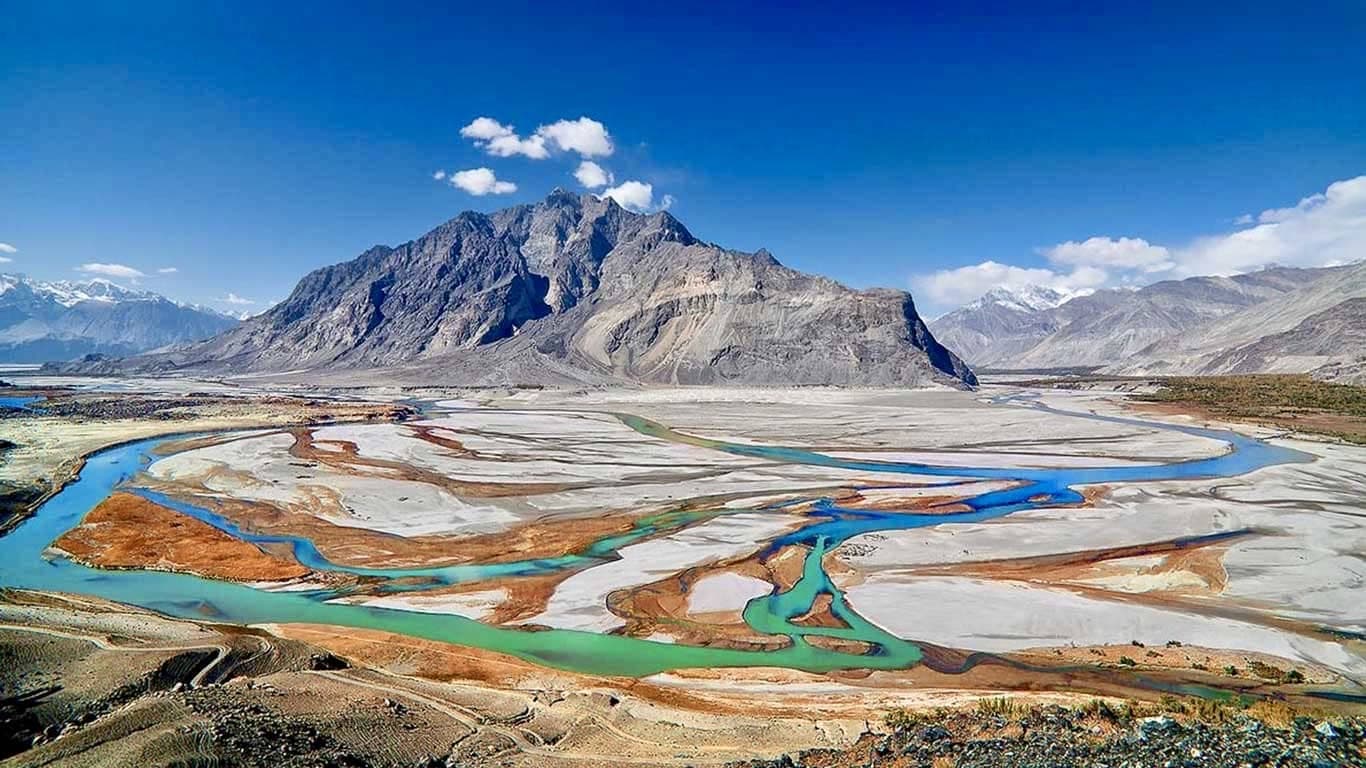
Kharpocho Fort above the town where the Shigar meets the Indus, the Shigar valley and its restored seventeenth-century fort, the Sarfaranga cold desert dunes, and Upper Kachura lake in the afternoon. A deliberate day off the rough roads: the jeeps are checked over, tyres and fuel sorted, and the camp kit loaded for Deosai. Anyone who wants a last hot shower for two days should take it tonight.
Day 11Onto the Deosai plateau — 4,114 m — and camp

Thirty kilometres and a world away. The track climbs out of Skardu past Sadpara and up onto the plateau, and then there is nothing above you but sky: open grassland above the treeline in every direction, no trees at all, wildflowers through July, marmots on every bank and streams the colour of glass. Camp is pitched near Sheosar lake at 4,142 metres, with Nanga Parbat on the southern horizon when the air is clear. It is close to freezing after dark even in August, the camp is ours — tents, mess, kitchen and crew — and the night sky is as good as it gets anywhere on earth.
Day 12Across Deosai to the Astore valley

The rest of the plateau in the morning, which is the best time of day for bears — there are around seventy-seven Himalayan brown bears on Deosai, up from roughly twenty when the park was declared in 1993, and while nothing is promised the drivers know the ground and where to put the binoculars. Off the western side of the plateau and down into the Astore valley, losing two thousand metres in an afternoon and going from tundra to apricot trees in about three hours.
Day 13Astore to Naran over Babusar, or down the Karakoram Highway

Out of the Astore valley to the Karakoram Highway and south. If Babusar is open and the weather is settled we go back over it into Kaghan, which is the better road and closes the loop rather than repeating it; if the pass has shut, we run the KKH the whole way, which is longer and equally fine — the Indus gorge below Chilas is one of the great drives in Asia in its own right. A long day either way, and the last of the high country.
Day 14To Islamabad, and onward

Down out of the hills and into Islamabad by early afternoon, with the Margalla ridge as the last thing the jeeps come around. A day room at the hotel, time to wash two weeks of Deosai dust out of everything and repack properly, and a transfer to the airport for an evening flight. Most international departures from Islamabad leave late, which is why the fortnight ends on the road rather than needing a fifteenth day.
What’s included
- 4x4 jeeps with experienced drivers for the whole route, four passengers to a vehicle
- Thirteen nights: hotels and guest houses throughout, and a full-service camp on Deosai
- All meals from Islamabad to Islamabad, including camp catering on the plateau
- An English-speaking guide with the convoy for the whole fortnight
- Full camp equipment on Deosai — tents, mess tent, kitchen, crew and toilet tent
- Deosai National Park fees, Khunjerab National Park fees and all site entry charges
- The Raikot jeep transfer to Tato and the return, for Fairy Meadows
- All airport transfers, and a day room in Islamabad on the last day
Not included
- International flights to and from Islamabad
- Pakistan visa, currently around US$ 100 — see our visa guide
- Travel insurance, which should cover road travel and camping to 4,500 metres
- Sleeping bag for the Deosai night — hire in Skardu is possible and is charged locally
- Pony or porter at Fairy Meadows for anyone not walking the ninety minutes up from Tato
- Drinks, tips, laundry and anything personal
- Domestic flights, if you choose to fly one leg rather than drive it
Good to know
The season is set by the passes, not by preference
July to mid-September. That is not a marketing window, it is arithmetic: Babusar is open roughly April to September, the Deosai tracks are under snow until late June, and Khunjerab is a summer road. The only period when all of them are open at once is high summer, and even then an early snowfall in September can shut Babusar overnight. We carry the Karakoram Highway alternative for exactly that, and it costs you a view rather than a day.
What the roads are actually like
About half the route is sealed and about half is not. The unsealed half is corrugated gravel, plank bridges over glacial rivers, and a certain amount of shelf road with a drop on one side — the Raikot track up to Fairy Meadows being the piece everyone has seen a video of. The drivers do it for a living, the vehicles are maintained for it, and it is a great deal safer than it looks. But if exposure genuinely bothers you, this is the wrong trip and we would rather tell you now than at the second hairpin.
Fourteen days in a jeep, honestly
Four passengers to a jeep, so everyone has a window and nobody spends two weeks in a middle seat. Driving days run from four to eight hours including stops, and there are three long ones: Hunza to Skardu, the Khunjerab run, and the last day out. The convoy stops when the light is worth it, which is the main practical advantage of three jeeps over one coach. Dust gets into everything on the unsealed sections — pack a dry bag for cameras and a scarf for your face, both of which you will use daily.
Altitude on a jeep safari
You sleep at 2,400 m in Naran, 3,300 m at Fairy Meadows and 4,114 m on Deosai, in that order, which is a sensible progression rather than an accident of routing. The Khunjerab day is a drive-up to 4,693 m and straight back down, and that is where people most often feel it — a headache at the gate is common and passes on the descent. Drink more water than you want to, skip the cigarettes at the top, and tell the guide rather than tough it out.
The night on Deosai
The camp on the plateau is the only night not in a building and the one people remember. At 4,114 m it gets close to freezing after dark even in August. Bring a sleeping bag rated to 0 °C — hire is possible in Skardu but your own is better — and a hat to sleep in. Tents, mess tent, kitchen, crew and the park fees are ours and included. There is no mobile signal on the plateau and Skardu is about three hours back down the track, so the day's medical kit travels with the convoy.
Brown bears, and what can honestly be promised
Deosai's Himalayan brown bear population has gone from roughly twenty when the park was created in 1993 to about seventy-seven now, where it has sat for the last four years. That makes a sighting genuinely possible and nowhere near guaranteed — usually at distance, usually early morning, usually from the vehicle. Bring binoculars. Anyone who promises you a bear is selling something. Marmots, by contrast, are a certainty, and golden eagles and ibex are both realistic.
Passports, permits and the Khunjerab border
No separate permit is needed for the standard route, but foreign passports are recorded at checkposts along the Karakoram Highway and on the Astore road, so keep your passport in the jeep rather than the roof bag and carry a few photocopies. Khunjerab National Park charges an entry fee, which is included. You can stand at the border gate; you cannot cross it on this trip — entering China needs a Chinese visa arranged well in advance and a different itinerary altogether.
What to pack that people forget
A windproof layer and a warm hat, for the passes rather than the valleys — Khunjerab in August can be five degrees with a wind on it while Chilas is thirty-eight. Sunglasses and high-factor sun cream; the ultraviolet at 4,000 m is severe and Deosai has no shade whatever. Boots for the Fairy Meadows walk, a head torch for the camp, binoculars for the plateau, and twice the camera storage you think you need.
Who this suits, and who it does not
People who want to cover ground and are not interested in trekking. There is one optional walking day and nothing else longer than an hour. It suits photographers, it suits anyone who has already done a Hunza road tour and wants the half of the north they missed, and it suits families with older children. It does not suit anyone who dislikes long days in a vehicle, anyone who needs a hot shower every night, or anyone who wants the Karakoram on foot — for that, the K2 base camp trek is the trip, not this one.
Questions about this trip
How much does a jeep safari in Pakistan cost?
From US$ 1,950 per person for the full fourteen days, and what moves that figure is mostly the size of your party. A jeep costs the same whether three people or four are sitting in it, so a group that fills its vehicles pays less per head than a couple travelling alone. The price covers the jeeps and drivers, thirteen nights, all meals, the guide, the Deosai camp and the national park fees. It does not cover international flights, the Pakistan visa, insurance, or a sleeping bag for the plateau. Tell us your numbers and dates and you get a quotation built on them rather than a headline.
What is the best time for a jeep safari in northern Pakistan?
July to mid-September, and the window is set by the passes rather than by the weather you would prefer. Babusar is open roughly April to September, the Deosai tracks lie under snow until late June, and Khunjerab is a summer road. High summer is the only period when all four crossings are open at once. Late June and late September can both work for a modified route, and we will say honestly which sections would be at risk on your dates rather than sell you a fortnight that ends in a detour.
What vehicles do you use, and how many people share a jeep?
High-clearance hard-top 4x4s maintained for unsealed mountain roads, with a driver who runs these routes for a living and stays with the group for the whole fortnight. Four passengers per jeep is our limit, so everyone has a window and nobody is in a middle seat for two weeks. We run a maximum of three jeeps, which caps the group at twelve — small enough that the convoy can stop where the light is good rather than keeping to a coach schedule. Luggage travels on the roof under a cover; a day bag stays inside with you.
How many hours a day are we driving?
Four to eight hours including stops, with three long days in the fortnight — Hunza to Skardu, the Khunjerab run and the final drive out. The rest are shorter, and two days involve almost no driving at all. This is a trip built on the drives rather than one that endures them, so the schedule allows for photograph stops, tea, and the fact that a Karakoram road will occasionally hold you up for an hour with no notice. If sitting in a vehicle for a large part of the day is not your idea of a holiday, be honest with yourself before booking.
Do you need a 4x4 for the Deosai plateau?
Yes, and it is not a preference. The Deosai tracks are unsealed, cross water, and climb to just over 4,100 m; two-wheel-drive vehicles regularly come unstuck on them and recovery is hours away. The crossing from Skardu to Astore over the plateau takes the better part of two days at touring pace, which is why we camp rather than rush it. Park fees are included and the camp is ours — tents, mess, kitchen and crew — so nothing about the night on the plateau depends on what happens to be available up there.
How high is the Khunjerab Pass, and can you cross into China?
4,693 metres, which makes it the highest paved international border crossing in the world, and it is roughly four hours from Karimabad on sealed road the whole way. You can walk up to the gate, photograph the marker and stand with one foot in each country. You cannot cross on this trip: entering China needs a Chinese visa arranged well in advance, and the onward journey is a different itinerary. The pass sits inside Khunjerab National Park, where yaks, marmots and sometimes ibex are on the road, and the entry fee is included.
Will I see a brown bear on Deosai?
Possibly, and nobody can promise it. The park holds around seventy-seven Himalayan brown bears, up from roughly twenty when it was created in 1993, and the population has been flat for the last four years. Sightings are usually at distance and usually early in the morning, which is when we are moving across the plateau. Bring binoculars. Marmots are guaranteed, golden eagles and ibex are realistic, and the drivers know the ground well enough to know where to look — which is a genuinely better chance than driving across on your own, and still not a guarantee.
Is the Karakoram Highway safe to drive?
The sealed sections are in better condition than their reputation suggests — much of the route was rebuilt in the last fifteen years, including the tunnels around Attabad Lake. The real hazards are rockfall after rain, landslide closures that can hold a road for hours, and other drivers. Our answer to all three is local drivers who read the ground, daylight driving only, and a schedule with enough slack that nobody is pushing to make a hotel. The unsealed sections, including the Raikot track, are driven by local specialists who do nothing else.
Can you drive all the way to Fairy Meadows?
No, and this is the question we are asked most. The jeep track from Raikot Bridge ends at Tato, and from there it is about ninety minutes on foot — or on a pony, which can be arranged locally — up through the pines to the meadow at 3,300 m. The track itself is driven only by the local jeep union; no outside vehicle is permitted on it, ours included, and that rule is the reason it has a safety record at all. The transfer both ways is included in your price; the pony is not.
Do I need to be fit, and what about altitude sickness?
Fitness barely matters. There is one optional walking day at Fairy Meadows and nothing else longer than an hour, and the trip is graded on the seat rather than the legs. Altitude does matter, mildly: you sleep at 2,400 m, then 3,300 m, then 4,114 m in that order, which is a sound progression, and the only sharp exposure is the drive-up to 4,693 m at Khunjerab and straight back down. Headaches at the gate are common and pass on the descent. Anyone with a heart or lung condition should speak to a doctor first and tell us what was said.
Where do you sleep on a jeep safari?
Thirteen nights: hotels and guest houses everywhere they exist, and one full-service camp on Deosai where they do not. Standards vary honestly with the geography — comfortable hotels in Islamabad, Karimabad and Skardu, simpler guest houses in Chilas and Astore, and a mountain hut or cabin at Fairy Meadows where there is no road at all. Everything is booked ahead. If a particular night matters to you, ask and we will tell you exactly what the property is rather than describe all thirteen as four-star.
Do foreign travellers need permits for this route?
No special permit is required for the standard route through Kaghan, Chilas, Hunza, Khunjerab, Skardu, Deosai and Astore. Passports are recorded at checkposts along the way, so keep yours to hand and carry photocopies. What you do need is a Pakistan visa, which most nationalities now get through the online system, and we issue an invitation letter for it on request. Restricted areas closer to the Line of Control and certain border zones need permits we would apply for in advance; nothing on this itinerary goes into them.
How is this different from a Hunza road tour or a Gilgit-Baltistan tour?
A road tour takes a coach or a minibus, stays on sealed roads, and picks one side of the north — Hunza and the Karakoram Highway, or Skardu and Baltistan. A jeep safari takes both and joins them with the routes a coach cannot use: Babusar, the Raikot track and the Deosai plateau. You trade some comfort for range, and you sleep one night in a tent at 4,114 m. If the driving is the part you would rather skip, take the Hunza Skardu tour instead; if the unsealed roads are the reason you are here, this is the trip.
Explore the region

You might also consider
Enquire about this trip
Tell us who is travelling and roughly when. A trip planner — not a call centre — replies within three hours between 9am and 11pm Pakistan time with a day-by-day itinerary and the full price, per person, with nothing hidden underneath it.
- Every itinerary written from scratch around your dates.
- Licensed operator, running these routes since 2014.
- A full costing up front — no deposit to see one.
- +92 310 5344471
- info@elhamasia.com
- 9am – 11pm PKT, seven days a week
- Office No. 227, Rohtas Road, G-9/1, Islamabad, Pakistan


