
Hunza Valley Autumn Tour
- 10 days, October to mid-November
- Khunjerab Pass, 4,693 m
- The clearest air of the year
- Maximum 14
- Hotels throughout
- Sunrise at Duikar
- Karakoram Highway both ways
- 10-day itinerary
About this tour
Autumn is the connoisseurs' season in Hunza and the argument for it is not only colour. From the second week of October the poplars that line every field boundary turn a hard yellow, the apricot orchards go red and orange, and the willows follow. But the thing regulars come back for is the air. The summer haze that sits over the valley through July and August is gone by mid-October, and Rakaposhi at 7,788 metres, Diran and the Ultar spires stand out with an edge they simply do not have in the trekking season.
It is also quiet. The trekkers have gone home, the Khunjerab traffic has thinned, and Karimabad in late October is a town rather than a queue. The trade-off is temperature and risk: mornings are cold from mid-October and properly cold by November, valley hotels are heated to a standard best described as optimistic, and the first serious snow can close the Khunjerab road any time from late October. We plan around that rather than pretend it will not happen.
The colour moves like the blossom does, only in reverse — upper Hunza and Gojal turn first because they are higher and colder, and lower Nagar holds on latest. Mid-October to the first week of November is the reliable band. This itinerary follows the Karakoram Highway up through Nagar to Karimabad, out to the Khunjerab Pass, back through Gojal and home, with the days weighted to wherever the colour is best that week.
Trip highlights
Gold from Nagar to Gojal
Poplars in full colour along every field boundary, with apricot orchards turning red behind them — a valley that farms intensively, and therefore has more trees to turn than anywhere comparable.
The clearest air of the year
From mid-October the summer haze lifts and Rakaposhi, Diran and Ultar stand out sharply. It is the reason autumn is the season photographers choose over spring.
Sunrise from the Eagle's Nest
Frost on the ground at Duikar and the peaks lighting in sequence, with Karimabad below still in shadow and gold.
A valley that belongs to itself again
The trekking season is over, the passes are emptying, and Karimabad in late October belongs to the people who live there.
Route
- 1 Start
- 2 Stop in order
- 8 Finish
- Route travelled
Loading map…
At a glance
- 10 days, October to mid-NovemberThe colour band runs about five weeks and turns top-down.
- Khunjerab Pass, 4,693 mWeather-dependent from late October. We have an alternative day if it closes.
- The clearest air of the yearThe summer haze has gone. This is when Rakaposhi photographs best.
- Maximum 14One minibus, 4x4s for the side valleys.
- Hotels throughoutTwin share en-suite. Heating is limited — see the notes.
- Sunrise at DuikarCold, dark, and the best half hour of the trip.
- Karakoram Highway both waysThe Gilgit flight is unreliable this late in the year.
Day by day
Day 1Arrive Islamabad
Met at the airport and driven to the hotel. Dinner and a briefing, including where the colour has got to — by October we can tell you which valleys have turned and which are a week off.
Day 2Islamabad to Chilas on the Karakoram Highway

Eight to nine hours up the Indus gorge, and an easier drive in October than in summer — the road is dry, the rivers are low and clear rather than glacial brown, and the heat of the plains has gone. Chilas for the night.
Day 3Chilas to Nagar and Karimabad
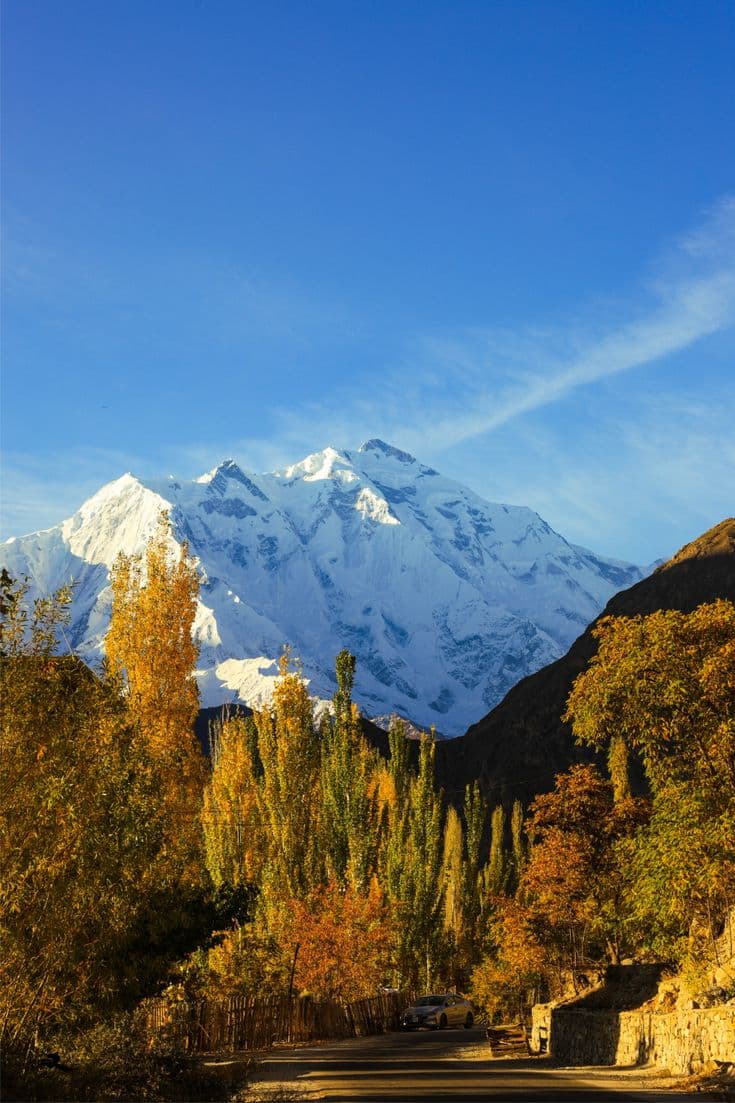
Five hours north with Nanga Parbat behind and the Rakaposhi viewpoint ahead. Lower Nagar holds its colour latest, so in a late-season departure this stretch is the best of it. Into Karimabad for three nights.
Day 4Karimabad — Baltit, Altit and the orchards

Baltit Fort above the town and Altit Fort below it, with the royal garden between them at its best in autumn. The lanes through Altit and Ganish run between apricot orchards that are red by late October. Short walking, a lot of stone steps, and the valley laid out below all day.
Day 5Sunrise at Duikar, and Hoper
Up to the Eagle's Nest before dawn — cold, frost on the ground by late October, and worth every minute as Rakaposhi, Diran, Golden Peak and Ultar light in sequence. Afterwards across to Nagar and the Hoper glacier, where the moraine and the turning scrub make an odd and very good combination.
Day 6The Khunjerab Pass — 4,693 m, weather permitting

Three to four hours up through Gojal to the Chinese border. In mid-October this is usually straightforward and stunning, with snow on the tops and gold in the valleys below. From late October the first heavy snow can close the road at short notice; if that happens we spend the day in upper Hunza instead, which is no consolation prize.
Day 7Upper Hunza — Attabad, Passu and Gulmit
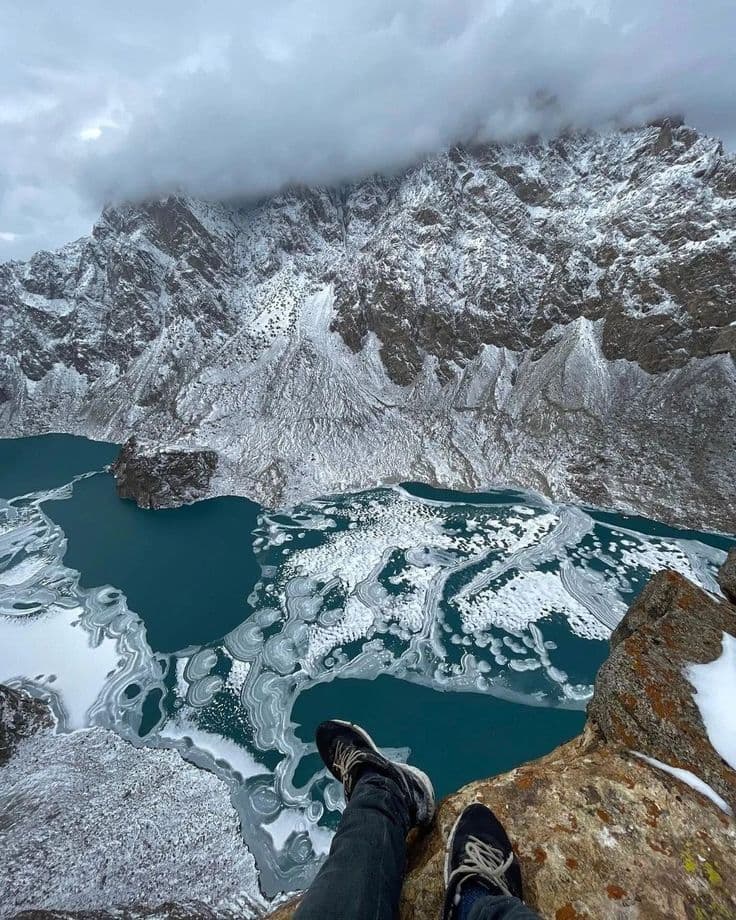
Gojal turns first, being highest, so on an October departure this is often where the colour peaks. Attabad Lake, which is a deeper blue in autumn than at any other time, the Passu Cones, the Hussaini bridge, and Gulmit with its poplars.
Day 8Hunza to Naran

Back down the Karakoram Highway. A long day and a beautiful one in autumn light, with the Kaghan valley turning at the far end of it. Naran for the night — and if heavy snow has already closed the Babusar side we take the standard KKH route, which is unaffected.
Day 9Naran to Islamabad
Down the Kaghan valley into the plains, five to six hours. An afternoon in Islamabad and a last dinner.
Day 10Departure
Transfer to Islamabad International. A day room if your flight is late.
What’s included
- All road transport on the Karakoram Highway, and 4x4 jeeps into the side valleys
- Nine nights in hotels, twin share with en-suite, breakfast included
- All meals from Islamabad to Islamabad
- English-speaking guide throughout
- Khunjerab National Park fees and all permits
- Airport transfers at both ends
- Entry to Baltit Fort, Altit Fort and the royal garden
Not included
- International flights to and from Islamabad
- Pakistan visa, currently around US$ 100 — see our visa guide
- Travel insurance
- Domestic flights if you would rather fly one leg — we will quote it, with the caveat below
- Lunch and dinner in Islamabad
- Tips, personal expenses and anything not listed above
Good to know
**When the colour turns**
The second week of October through to about mid-November, with the reliable band being mid-October to the first week of November. It runs top-down, the opposite of the blossom: Gojal and upper Hunza turn first because they are higher and colder, Karimabad follows, and lower Nagar holds its leaves longest. An early cold snap strips the upper valley quickly, so a late-October departure sometimes finds Gojal already bare and Nagar at its best. We weight the days accordingly once we can see it.
**Cold, and how cold**
This is the thing people underestimate. Karimabad in late October is around 15 °C in the afternoon sun and below freezing before dawn. By November the days are single figures. Valley hotels are heated with gas heaters in the room rather than centrally, hot water can be intermittent, and the Duikar sunrise is genuinely cold. Bring a down jacket, a hat and gloves, and thermals for the early starts. Nobody has ever regretted over-packing warm clothes on this trip.
**The Khunjerab risk**
The pass road is normally fine through mid-October and becomes a weather question after that. The first serious snow can close it with no notice, and the Pakistani authorities shut it rather than risk vehicles. We treat the Khunjerab day as conditional and have a full alternative in upper Hunza ready. If reaching the Chinese border matters to you specifically, come in October rather than November, or take the blossom tour in spring instead.
**Why not fly**
We drive both ways. The Islamabad–Gilgit flight is fifty minutes and lovely and cancels constantly in autumn and winter weather — and being stuck in Gilgit for two days at the end of a trip is a worse outcome than a long drive at the start. If the forecast is settled we will offer it for one leg.
**Autumn versus spring**
People ask which to choose. Spring gives you blossom against snow and warmer nights; autumn gives you stronger colour, far clearer air and a much quieter valley. If you are coming to photograph the mountains, come in autumn. If you are coming for the orchards in flower, come in April. The two trips follow almost the same road for a reason — it is the same valley — but they are not the same experience.
Questions about this trip
When is autumn colour at its best in Hunza?
Mid-October to the first week of November is the reliable band, within a broader season running from the second week of October to mid-November. The colour turns top-down: Gojal and upper Hunza go first because they are higher, Karimabad follows, and lower Nagar keeps its leaves longest. An early cold snap can strip the upper valley within days.
Is Hunza better in autumn or spring?
Autumn gives stronger colour, much clearer air and a far quieter valley — the summer haze has gone, so Rakaposhi and Ultar photograph better than at any other time. Spring gives you apricot and cherry blossom against fresh snow, and warmer nights. Photographers generally choose autumn; people who want the orchards in flower choose April.
How cold does Hunza get in October and November?
Karimabad is around 15 °C in afternoon sun in late October and below freezing before dawn; by November the days are in single figures. Hotels are heated with gas heaters in the room rather than centrally, and hot water can be intermittent. A down jacket, hat, gloves and thermals for the Duikar sunrise are the difference between enjoying it and enduring it.
Is the Khunjerab Pass open in autumn?
Usually through mid-October, and a weather question after that. The first heavy snow can close the road at short notice and the authorities shut it rather than risk vehicles. We treat that day as conditional with a full alternative in upper Hunza ready. If standing on the Chinese border matters to you specifically, book October rather than November.
Do you fly or drive to Hunza on this trip?
Drive, both ways, on the Karakoram Highway. The Islamabad–Gilgit flight is fifty minutes but cancels frequently in autumn weather, and being stranded in Gilgit at the end of a trip is worse than a long drive at the start. If the forecast is settled we will offer the flight for one leg and quote it.
Is there any trekking or altitude on the Hunza autumn tour?
No trekking, and no altitude problem. You sleep at 2,400 metres at the highest, and the only real height is an hour or so at the Khunjerab Pass, which is reached by road. Walking is limited to forts, village lanes and viewpoints. The long driving days are the main physical demand.
You might also consider
 Kalash Festival (Chilam Joshi)Four days in the Kalash valleys for Chilam Joshi, the spring festival — walnut branches, milk poured over thresholds, and dancing that goes on until the light fails. Nine days from Islamabad, with two full days in the valleys.From US$ 1,650
 Shandur Polo Festival TourThe world's highest polo ground at 3,743 metres, and the one week a year it is used. Gilgit against Chitral, no umpire worth the name, and ten thousand people camped on a pass with no village on it.From US$ 1,880
 Hunza Valley Cherry Blossom TourTen days through Hunza and Nagar in the two weeks the valley turns white and pink — apricot first, then cherry, moving up the valley with the altitude. Karimabad, Duikar and the Khunjerab Pass.From US$ 1,180
Enquire about this trip
Tell us who is travelling and roughly when. A trip planner — not a call centre — replies within three hours between 9am and 11pm Pakistan time with a day-by-day itinerary and the full price, per person, with nothing hidden underneath it.
- Every itinerary written from scratch around your dates.
- Licensed operator, running these routes since 2014.
- A full costing up front — no deposit to see one.
- +92 310 5344471
- info@elhamasia.com
- 9am – 11pm PKT, seven days a week
- Office No. 227, Rohtas Road, G-9/1, Islamabad, Pakistan