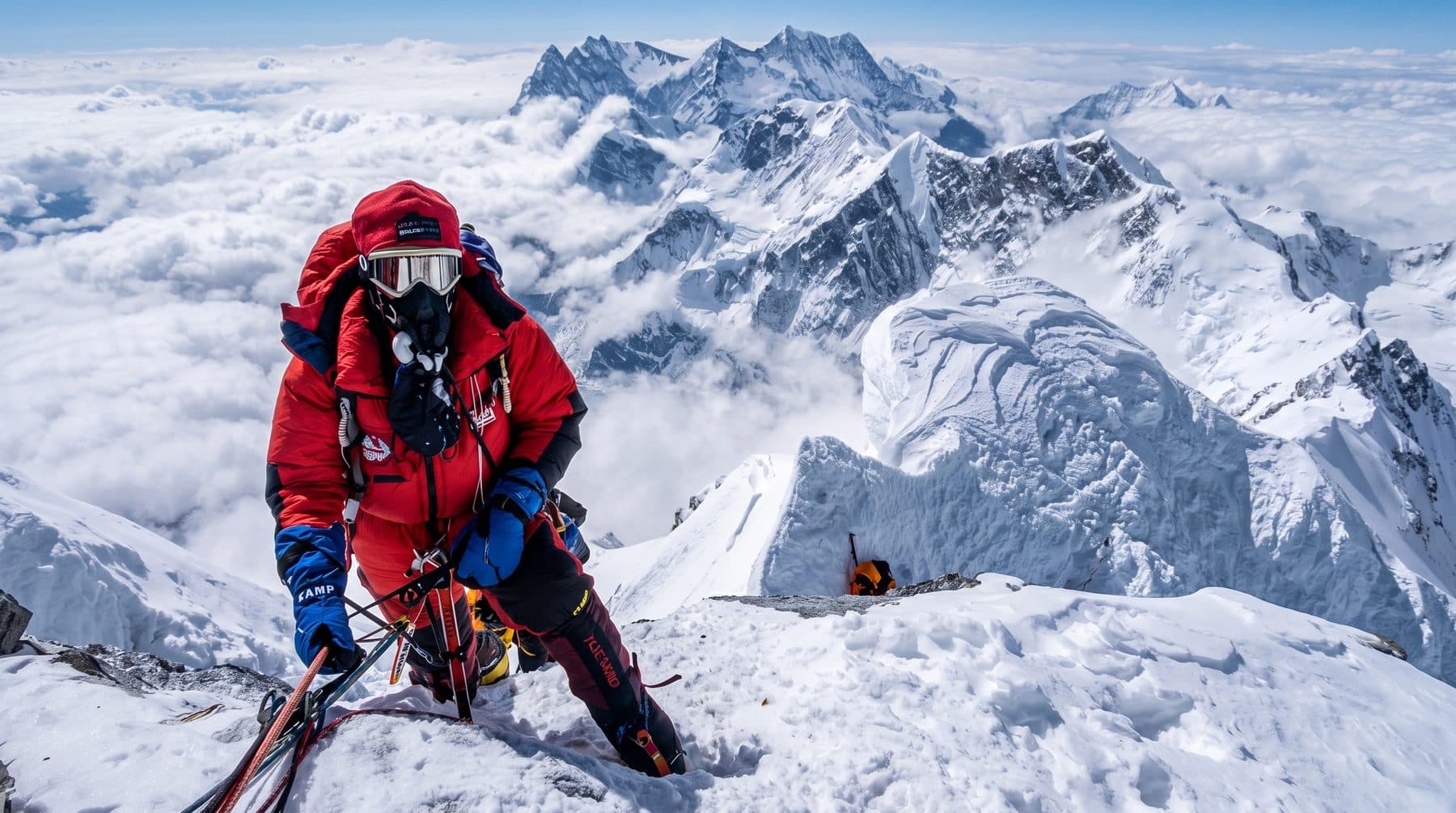
Mera Peak 6,476 m
- Mera North, 6,476 m
- Five 8,000ers from the summit
- 17 days, Kathmandu to Kathmandu
- The slow approach, on purpose
- A climbing Sherpa to every two
- Hinku valley, Nepal
- 17-day itinerary
About this tour
Mera Peak is the highest trekking peak in Nepal at 6,476 metres, and it is also one of the least technical things you can climb at that height. Those two facts together are the whole proposition. There is no headwall, no rock, and no sustained steep ground: summit day is a long walk on a glacier in crampons, roped, with one short steeper pull onto the summit cone at the end. What makes it hard is that it goes to 6,476 metres, and altitude is indifferent to how easy the ground is.
What you get for it is the best summit view in Nepal, and that is not a boast that needs qualifying. From the top you can see five of the world's fourteen 8,000 metre mountains at once — Everest, Lhotse, Makalu, Cho Oyu and, on a clear morning, Kangchenjunga on the eastern horizon. Nothing else reachable by a non-technical climber gives you that.
We go in the long way, through the lower Solukhumbu by way of Paiya and Panggom, and come out over the Zatrwa La when you are acclimatised. Most itineraries do the opposite because it is four days shorter: they cross the Zatrwa La at 4,610 metres on the second day out of Lukla, which is a 1,750 metre gain in 48 hours and the single most common reason people arrive at Khare already unwell. Our way costs four days and is the reason the summit day works.
The Hinku valley itself is the other argument for it. Almost nobody is there. It is a deep forested valley with no road, no airstrip and a handful of lodges, and after the Everest Base Camp trail — which is two valleys west and a different world — the emptiness is the thing people comment on most.
Summit day starts around two in the morning from a high camp at 5,780 metres, and it is cold in a way that is hard to convey. It is also, for most people who have got that far properly acclimatised, entirely achievable.
Trip highlights
Five 8,000 metre peaks from one summit
Everest, Lhotse, Makalu, Cho Oyu and — on a clear morning — Kangchenjunga on the eastern horizon. No other non-technical summit in Nepal puts five of the world's fourteen highest mountains in front of you at once.
6,476 m, without a headwall
The highest trekking peak in Nepal, climbed as a long roped glacier walk in crampons with one short steeper pull onto the summit cone. If you want the altitude rather than the technical difficulty, this is the mountain that gives it to you.
The long way in, through lower Solukhumbu
Four days more than the direct crossing of the Zatrwa La, and the reason people summit. The short version gains 1,750 metres in 48 hours out of Lukla and delivers a meaningful share of its clients to Khare already ill.
The Hinku valley, which is empty
No road, no airstrip, a handful of lodges and forest for two days. It is two valleys west of the Everest Base Camp trail and it might as well be a different country. Most people comment on the quiet before they comment on the mountain.
A summit morning at 5,780 m
Away from high camp at two in the morning onto the glacier in the dark, with the sun arriving somewhere around 6,000 metres and Makalu lighting up first. Cold in a way that is difficult to describe in advance.
Route
- 1 Start
- 2 Stop in order
- 10 Finish
- Route travelled
Loading map…
At a glance
- Mera North, 6,476 mThe highest trekking peak in Nepal, and one of the least technical.
- Five 8,000ers from the summitEverest, Lhotse, Makalu, Cho Oyu and Kangchenjunga on a clear morning.
- 17 days, Kathmandu to KathmanduIn through the lower Solukhumbu, out over the Zatrwa La.
- The slow approach, on purposeFour days longer than the direct route, and the reason the summit works.
- A climbing Sherpa to every twoOn summit day, from high camp at 5,780 m.
- Hinku valley, NepalPaiya, Kothe, Thaknak and Khare — a valley with no road and few people.
Day by day
Day 1Arrive Kathmandu, 1,300 m
Met at the airport and driven to the hotel. Kit check with the climbing guide, which for this trip means boots, a sleeping bag rated to about minus twenty-five, and enough down for a summit morning at 6,000 metres. Anything missing is hired in Thamel.
Day 2Kathmandu — permits and preparation
The Mera Peak climbing permit and Makalu Barun National Park entry are arranged today. A half day is genuinely useful here rather than padding: it is the last chance to swap a boot that does not fit, and the guides use it to go through the summit plan properly.
Day 3Fly to Lukla, 2,860 m, and trek to Paiya, 2,730 m
The morning flight into Lukla — from Ramechhap rather than Kathmandu in peak season, which means a very early road transfer. Then, instead of turning north with everyone else, you turn south: five to six hours over the Kalo Himal ridge and down into country almost no trekker sees.
Day 4Paiya to Panggom, 2,850 m
Five to six hours through rhododendron and bamboo, past small Rai and Sherpa settlements that live off their fields rather than off trekking. Panggom sits on a saddle with terraced farmland below it.
Day 5Panggom to Ningsow, 2,860 m
Four to five hours over the Panggom La and along the ridge, with the first distant sight of the mountains to the north. A short day, and deliberately: the height gain is being kept slow on purpose while the distance is not.
Day 6Ningsow to Chhatra Khola, 2,800 m
Seven to eight hours, and the longest day of the approach. The trail contours in and out of side valleys through dense forest — this is the section where people see langur and, occasionally, signs of red panda. You end the day no higher than you started it, which is the point.
Day 7Chhatra Khola to Kothe, 3,600 m
Six to seven hours climbing into the Hinku valley proper, following the river north with the walls rising either side. Kothe is a scatter of lodges in the forest and the first place the trek feels committed.
Day 8Kothe to Thaknak, 4,360 m
Three to four hours up the valley, past the Gompa at Gondishung and a small monastery under a boulder, with the treeline ending as you go. Thaknak is a summer grazing settlement of stone huts and a couple of lodges, and Mera itself finally appears at the head of the valley.
Day 9Thaknak to Khare, 5,045 m
Two to three hours only, climbing beside the Dig glacier moraine to Khare, which is base camp in everything but name. The afternoon is spent doing nothing at all, which at 5,045 metres is work.
Day 10Khare — acclimatisation and the skills day
A full day: a climb to about 5,300 metres on the moraine above the village and back down, and then several hours on real ice with the climbing Sherpas — crampons, ice axe, harness, roped movement and using a fixed line. Mera needs less technique than Island Peak, but roped glacier travel at 6,000 metres is not something to meet for the first time on summit day.
Day 11Khare to Mera High Camp, 5,780 m
Six to seven hours, and the day the trip becomes an expedition. Up onto the Mera La at about 5,400 metres, roped, and then across the glacier to a high camp on a rock shelf above it. Tents, a cook crew and an early meal. The view from the shelf at sunset takes in Makalu, and nobody sleeps much.
Day 12Summit day — Mera North, 6,476 m — and down to Khare
Away around two in the morning, roped, onto the glacier in the dark. A long steady ascent on snow with the angle never becoming severe — the difficulty is the cold, the altitude and the duration rather than the ground. Sunrise arrives somewhere around 6,000 metres with Makalu lighting first. A short steeper pull leads onto the summit cone and the top, where Everest, Lhotse, Makalu, Cho Oyu and Kangchenjunga are all visible on a clear morning. Then down the whole way to Khare. Eight to ten hours.
Day 13Reserve day
Held for the summit. Mera turns groups back for wind and for fresh snow on the glacier, and a team with a second attempt summits far more often than a team with one. If the summit went to plan, this is a descent day to Kothe instead.
Day 14Khare to Kothe, 3,600 m
Four to five hours back down the Hinku valley, losing 1,400 metres and finding trees and warm air again. Everything hurts less than it did on the way up.
Day 15Kothe to Thuli Kharka, 4,300 m
Five to six hours climbing out of the Hinku on the western side towards the Zatrwa La. A last long look back up the valley at Mera, which from here shows the whole of the route you climbed.
Day 16Over the Zatrwa La, 4,610 m, to Lukla, 2,860 m
Six to seven hours: a climb to the pass with Numbur, Kongde and the Dudh Kosi valley laid out beyond it, then a long steep descent to Chutanga and on to Lukla. Crossing it in this direction, fully acclimatised and going down, is a very different day from crossing it on day two — which is exactly why we do it this way round.
Day 17Fly to Kathmandu and depart
Early flight out, weather permitting, with a day room held in Kathmandu for a shower and repacking before onward flights. Keep a spare day in your international ticket for Lukla.
What’s included
- CONFIRM — Kathmandu–Lukla–Kathmandu flights, or the Ramechhap transfer and flight in peak season
- Three nights in Kathmandu, twelve in lodges on the trail and one under canvas at high camp
- All meals on trek and at high camp
- A licensed English-speaking trekking guide throughout, and a climbing Sherpa to every two people on summit day
- Group climbing equipment: ropes, ice screws, snow bars, harnesses, helmets, crampons and ice axes
- Porters, one between two trekkers, with a capped load and rescue insurance
- Mera Peak climbing permit and the Makalu Barun National Park entry permit
- High camp tents, kitchen and cook crew, first aid kit and emergency oxygen
Not included
- International flights to and from Kathmandu
- Nepal visa, issued on arrival
- Travel insurance — which must cover climbing to 6,500 m and helicopter evacuation, and is a condition of joining
- Personal clothing, mountaineering boots and a sleeping bag rated to minus twenty-five
- Meals in Kathmandu other than breakfast
- Drinks, hot showers, wifi, battery charging and laundry on the trail
- Tips for the guides, cook and porters
- Costs arising from an early descent, a rescue or a delayed Lukla flight
Good to know
Why this itinerary is four days longer than the cheap one
Most Mera Peak trips cross the Zatrwa La at 4,610 metres on the second day out of Lukla. That is a gain of about 1,750 metres in 48 hours, and it is the single most common reason people arrive at Khare unwell and never leave it. It is also four days cheaper, which is why it is everywhere.
We go in south through Paiya, Panggom and Ningsow — lower, longer, and rising slowly — and cross the Zatrwa La on the way out when you are acclimatised and descending. If you are comparing quotations and ours is longer and dearer, this is what the difference buys.
Higher than Island Peak, and easier
Worth being clear about, because we sell both. Mera is 6,476 metres against Island Peak's 6,189, so it is the bigger number. But Island Peak finishes with 100 to 125 metres of fixed rope on a headwall at 45 to 50 degrees, and Mera does not: Mera is a long roped walk on a glacier with one short steeper section at the top.
So if you want the altitude and the view, take Mera. If you want to learn to climb, take Island Peak. People who want both usually do Mera first.
Summit day, and the cold
Away from high camp around two in the morning, eight to ten hours up and down, on snow throughout. The ground is not the problem. The cold is: 6,000 metres before dawn in the pre-monsoon or post-monsoon season is somewhere between minus twenty and minus thirty with any wind on top of that, and fingers and toes are what end most people's summit day rather than legs or lungs.
Take this seriously with your gloves and your boots. Double mountaineering boots are strongly preferred over single, we will say so again when you book, and hiring them in Kathmandu is easy and cheap compared with frostbite.
What high camp is
One night in a tent on a rock shelf at 5,780 metres, with a cook crew and not much else. It is the highest most people will have slept, it is cold, and nobody sleeps well. This is normal and it is not a sign anything is wrong.
Altitude
The approach is built to handle it and it still bites. You sleep at 5,045 metres at Khare for two or three nights and at 5,780 the night before the summit. The usual rules: a headache that will not lift with fluid and painkillers, vomiting that will not stop, confusion or any loss of coordination mean going down immediately, whatever the hour. The climbing Sherpas carry a pulse oximeter and emergency oxygen, and the decision to turn someone round is theirs and is not negotiable.
Insurance, specifically
Cover for mountaineering to 6,500 metres and helicopter evacuation. Trekking cover is not enough and a standard travel policy is nowhere near. The Hinku valley has no road and no airstrip, so a helicopter is the only way out that is not several days of walking. We ask for the policy number and the emergency line before you fly.
The Lukla flight
In peak season it operates from Ramechhap rather than Kathmandu, a four to five hour drive east starting around one in the morning. It is also a weather flight in both directions and days go every season. Keep at least one spare day in your international ticket, two if changing it is expensive.
Permits
The Mera Peak climbing permit and the Makalu Barun National Park entry permit, both included and both arranged in Kathmandu. Mera sits inside the national park rather than in Sagarmatha, which is why the permits differ from the Everest trek.
Questions about this trip
How difficult is Mera Peak?
Physically strenuous and technically straightforward, which is an unusual combination. Summit day is a long roped walk on a glacier in crampons with one short steeper section onto the summit cone — no headwall, no rock, no sustained steep ground. What makes it hard is the altitude, the duration, and the cold at 6,000 metres before dawn. If you are fit enough for a two-week trek and willing to learn crampon and rope work in a day, you can climb Mera.
Is Mera Peak harder than Island Peak?
Higher, and easier. Mera is 6,476 metres against Island Peak's 6,189, so it is the bigger summit. But Island Peak finishes with 100 to 125 metres of fixed rope on a headwall at 45 to 50 degrees, and Mera has nothing like it. If you want the altitude and the view, climb Mera; if you want to learn technical skills, climb Island Peak. We sell both and will say the same thing on the phone.
Can you really see five 8,000 metre peaks from the summit?
Yes, on a clear morning: Everest, Lhotse, Makalu, Cho Oyu and Kangchenjunga on the eastern horizon. Makalu is the closest and the most striking, and it is usually the first to light up. This is the reason to climb Mera rather than something easier to reach — no other non-technical summit in Nepal gives you that view.
Why is your itinerary 17 days when others are 13?
Because the short ones cross the Zatrwa La at 4,610 metres on the second day out of Lukla — a gain of roughly 1,750 metres in 48 hours. It is the most common reason people reach Khare too ill to go higher. We go in south through Paiya and Panggom instead, climbing slowly, and cross the Zatrwa La on the way out when acclimatised. Four extra days, and it is the difference between a summit and a story about being ill in a lodge.
Do I need climbing experience?
No. You need hill fitness and a willingness to learn. The skills day at Khare covers crampons, ice axe, harness, roped glacier travel and using a fixed line, taught by the Sherpas who will be roped to you on summit day. Mera asks less of these skills than Island Peak does, but roped movement on a glacier at 6,000 metres is not something to encounter for the first time in the dark.
What boots and gear do I need?
Double mountaineering boots are strongly preferred over single for summit day — the cold at 6,000 metres before dawn is what ends most attempts, and it takes fingers and toes rather than legs. Bring your own boots and clothing and a sleeping bag rated to about minus twenty-five for high camp. We provide ropes, ice screws, snow bars, harnesses, helmets, crampons and ice axes. Boots and down can be hired in Kathmandu cheaply.
What is the high camp like?
One night in a tent on a rock shelf at 5,780 metres with a cook crew and nothing else. It is the highest most people will have slept and almost nobody sleeps well there. That is normal rather than a warning sign. Dinner is early, the wake-up is around one in the morning, and the view at sunset takes in Makalu.
When is the best season for Mera Peak?
March to May and late September to November. Autumn gives the clearest air and the best chance of seeing all five 8,000 metre peaks from the top; spring is a little warmer with more snow on the glacier and rhododendron in the lower Hinku. Winter ascents happen but the cold at 6,476 metres becomes the whole story, and the monsoon closes it.
What insurance do I need?
Cover for mountaineering to 6,500 metres and helicopter evacuation. Trekking cover to 6,000 metres is not sufficient for this trip and standard travel insurance covers neither. The Hinku valley has no road and no airstrip, so a helicopter is the only evacuation that is not several days of walking out. We ask for the policy number and the 24-hour emergency line before you fly.
What happens if I cannot summit?
You come down with a member of the crew, and it is neither unusual nor a problem. Some people turn round at high camp, some on the glacier. The reserve day means a second attempt is often possible if the reason was weather rather than how you feel. Nobody is ever pushed past the point the climbing Sherpa is comfortable with, and that decision is theirs rather than yours or ours.
Enquire about this trip
Tell us who is travelling and roughly when. A trip planner — not a call centre — replies within three hours between 9am and 11pm Pakistan time with a day-by-day itinerary and the full price, per person, with nothing hidden underneath it.
- Every itinerary written from scratch around your dates.
- Licensed operator, running these routes since 2020.
- A full costing up front — no deposit to see one.
- +92 310 5344471
- info@elhamasia.com
- 9am – 11pm PKT, seven days a week
- Office No. 227, Rohtas Road, G-9/1, Islamabad, Pakistan


